AI Detection and Response (ADR)
BigPanda AI Detection and Response (ADR) catches incidents early and resolves them faster. ADR brings together Event Intelligence and AI Triage in a single platform, analyzing real-time signals from your monitoring tools, service desk, and external dependencies to detect issues before they affect your business.
ADR correlates data from across your environment, identifies whether issues are related, filters out noise, and separates real incidents from false positives so your team can focus on what matters.
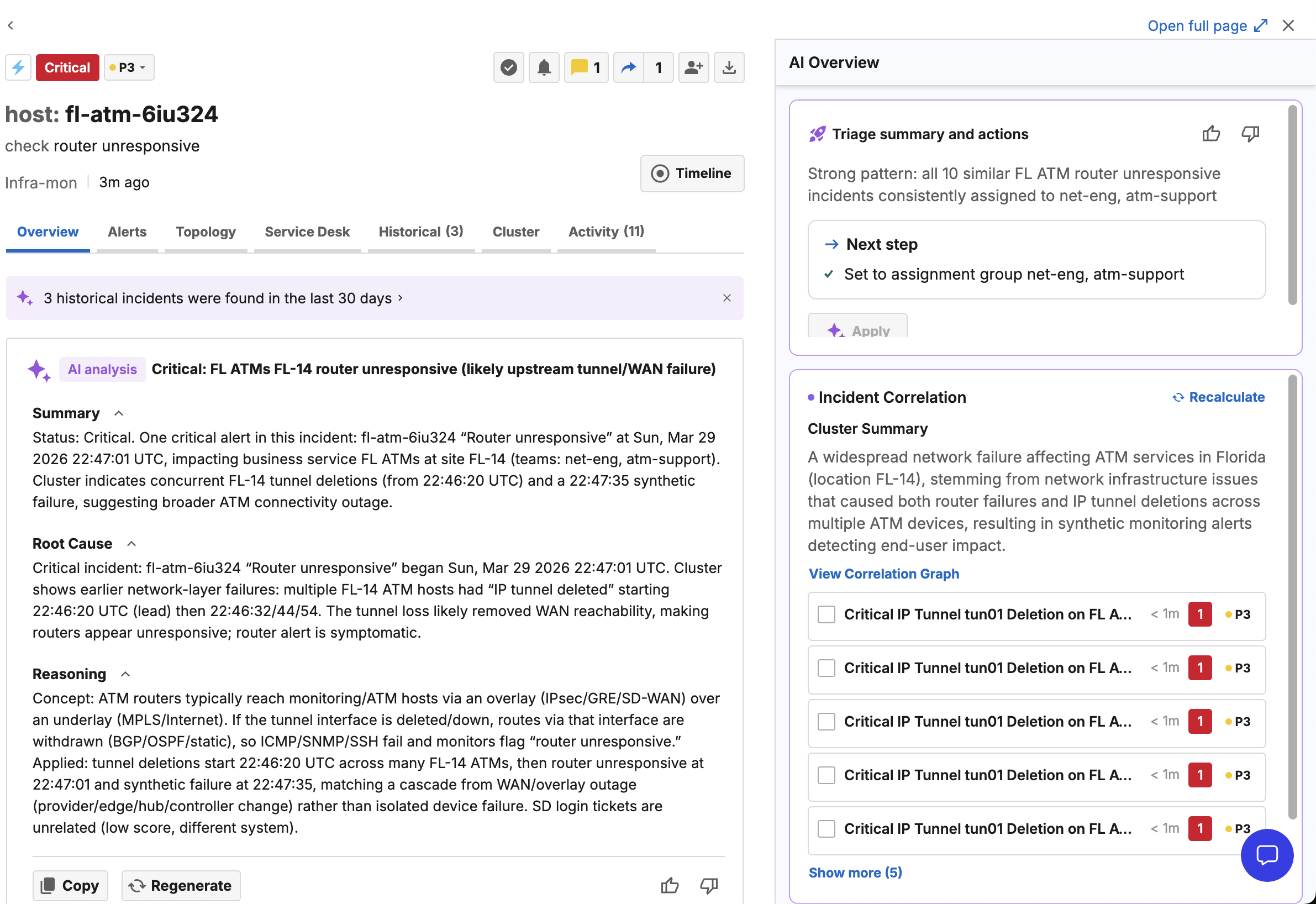
ADR in BigPanda Console
Key features
Detect earlier - Identify emerging issues before they escalate by correlating signals across your entire environment.
Diagnose faster - Enrich every incident with context from past incidents, recent changes, and configuration data, then surface root cause and next steps automatically.
Resolve with confidence - Reduce escalations with AI-suggested remediation and context-rich handoffs when escalation is needed.
Detect
Teams using ADR detect incidents earlier, before they affect customers. ADR correlates signals across your monitoring tools, service desk, and external providers to surface problems while they are still containable.
Alert and Incident correlation - Groups related alerts across applications and domains so your team focuses on root causes, not individual alerts. Correlation reveals hidden dependencies and determines the full blast radius of an incident.
Service desk observability - Connects service desk tickets to system incidents for cross-team visibility, helping your team prioritize based on end-user impact.
Open Integration Hub - Works with your existing monitoring tools across cloud, on-premises, and hybrid environments with no tool consolidation required.
Diagnose and Triage
ADR cuts diagnosis time by automatically enriching every incident with the context your team needs to understand what happened, why, and what to do next.
AI Incident Analysis (AIA) - Provides plain-language incident summaries and potential root cause analyses for every incident. See recommendations for triage and resolution based on past similar incidents, recent changes, and your monitoring environment.
Alert and Incident enrichment - Normalizes raw data from your systems and adds operational context, including business segment and service information, so your team can identify meaningful patterns quickly.
Historical and similar incidents - Matches current incidents against past resolutions and patterns so your team can apply proven solutions instead of starting from scratch.
Root cause change tracking - Correlates recent changes with incident timing and surfaces relevant change events, helping your team quickly determine whether a recent change is the root cause.
Impact assessment and prioritization - Assesses the business impact of each incident and recommends priority and next steps, so your team knows what to work on first.
Respond
ADR helps your team close incidents faster and escalate less. When escalation is needed, the receiving team gets full context and can act immediately.
Automated ticketing and notifications - Integrates with your IT Service Management (ITSM) and ticketing tools to create and update tickets automatically as incidents progress.
Context-rich escalation - When L2 involvement is needed, ADR enriches tickets with full incident context so the receiving team can begin investigation immediately.
The L1 Agent and ADR Products
The ADR and L1 Agent products build together to further accelerate first-response. ADR 's AI triage helps your L1 team work faster and more consistently by providing AI-driven detection and triage insights. The L1 Agent takes the next step by removing action items from L1 workloads entirely. Organizations that leverage both products will see impact multiply.
ADR Product: AI Triage & context
AI incident analysis (AIA)
Incident correlation
Service desk observability
Historical and similar incidents
Root cause changes
L1 Agent Product: Automated actions
Automatic ticket routing
Runbook automation
Coming soon:
Automatic prioritization
Escalation logic
Suppression and noise reduction
Auto-resolution
ADR Features at a glance
Stage | Capabilities |
|---|---|
Detect | Incident Correlation, Service Desk Observability, External Observability, Open Integration Hub |
Diagnose and Triage | AI Incident Analysis, Incident Enrichment, Historical and Similar Incidents, Root Cause Change Tracking, Impact Assessment |
Respond | AI-Suggested Remediation, Automated Ticketing and Notifications, Runbook Automation, Context-Rich Escalation |
Powered by the BigPanda IT Knowledge Graph, which unifies data from your monitoring tools, ITSM records, knowledge bases, runbooks, change history, and topology sources.
ADR Documentation
The following features are available as part of ADR:
Incidents tab
Dashboards tab
Unified Analytics
Service Health Dashboard
Integrations
Configuration
Next Steps
Learn how the L1 Agent product builds on ADR with autonomous L1 automation.
Take your incident, problem, and change management to the next step with AI Incident Assistant and AI Incident Prevention.
Start detecting and responding to incidents with Incidents in BigPanda.