AI Incident Assistant Context and Data
The AI Incident Assistant Web App Context and Data module allows you to manage indexing settings, data, and documents. Choose the AI Incident Assistant generated content to automatically index, view your indexed data categories, and upload documents to provide additional context to AI Incident Assistant.
Key Features
Adjust indexing settings to control which AI Incident Assistant generated artifacts can be searched by users.
View the number of documents and last indexed data for each indexed data category.
Upload documents to give AI Incident Assistant additional context.
Indexing Settings
The AI Incident Assistant Indexing Settings allow you to control which content is automatically indexed and searchable by your users.
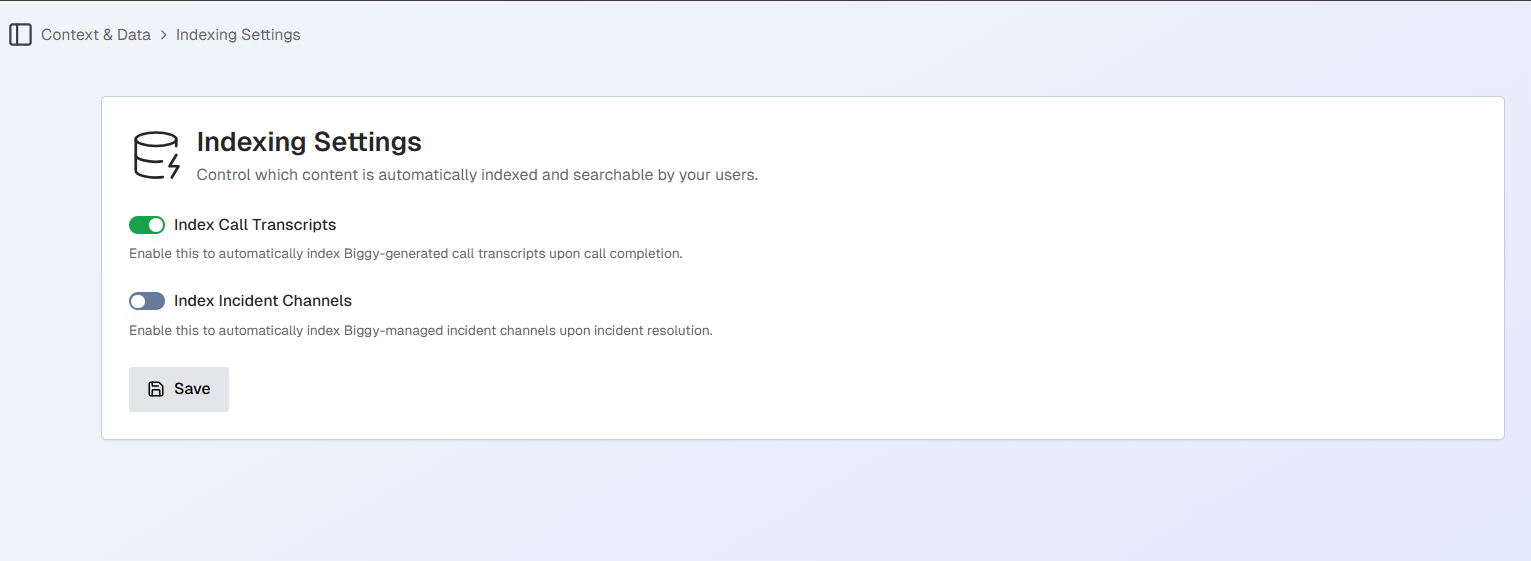
The Indexing Settings page is divided into three tabs:
General
Chat Indexing
Web Indexing
General
The following general indexing settings are available:
Setting | Description |
|---|---|
Index Call Transcripts | Automatically distill and index completed meeting transcripts into AI Incident Assistant's long-term knowledge, making them searchable and reusable. Note: This is separate from the Meeting Transcript Retention settings. |
Index Incident Channels | Automatically index AI Incident Assistant managed incident channels upon incident resolution. |
Index Major Incidents | Automatically index completed Major Incidents including incident details, action outputs, communication context, and resolution outcomes into AI Incident Assistant's long-term knowledge. |
Meeting Transcript Retention | Controls how long raw meeting transcripts from your meeting provider are retained. This impacts how long users can run queries and generate content, such as summaries, that directly use the raw transcripts. The maximum retention period is 30 days. The minimum is 3 hours. Note: This is separate from the Index Call Transcripts setting, which stores summarized interpretations of transcripts as long-term knowledge for AI Incident Assistant to use during context retrieval. |
Chat Indexing
Use Chat Indexing to capture and index Slack and Teams conversations into searchable knowledge for AI-powered retrieval.
Toggle Chat Message Indexing on to enable this feature.
After enabling, click +Add Channels to add Slack or Teams channels for indexing. Select one or more channels from the list, or use the Search bar to find a specific channel.
Select How far back to index the selected channel(s) from the drop-down menu.
Web Indexing
Use Web Indexing to index publicly accessible pages such as documentation sites into AI Incident Assistant's searchable knowledge.
Click + Add Web Source to add a new public URL. Populate the following information in the Add Web Source window:
URL - Public URL link.
Label (Optional) - Description of the URL.
Crawl Mode - Select Single to index only the URL included. Select Recursive to crawl the URL provided, and its subpages. If you select Recursive, choose the Max number of pages to crawl.
Sync Frequency - Select how often the web crawler should sync. You can select Manual, or choose a specific time frame. If you choose a time frame, use the Auto-sync toggle to determine whether the re-crawl will occur automatically on the selected schedule.
Manage Data
On the Manage Data page, you can view and explore your indexed and graph data.
The page is separated into the following tabs:
Data Counts
GraphDB Explorer
VectorDB Explorer
Data Counts
In the Data Counts tab, you can see an overview of your indexed documents across different source categories. AI Incident Assistant uses indexed document data to fulfill user requests.
The Data Counts tab is divided into two sections:
Vector DB Counts - current indexed document totals, by source.
Graph DB Counts - current graph coverage for ITSM, CMDB, and tacit knowledge.
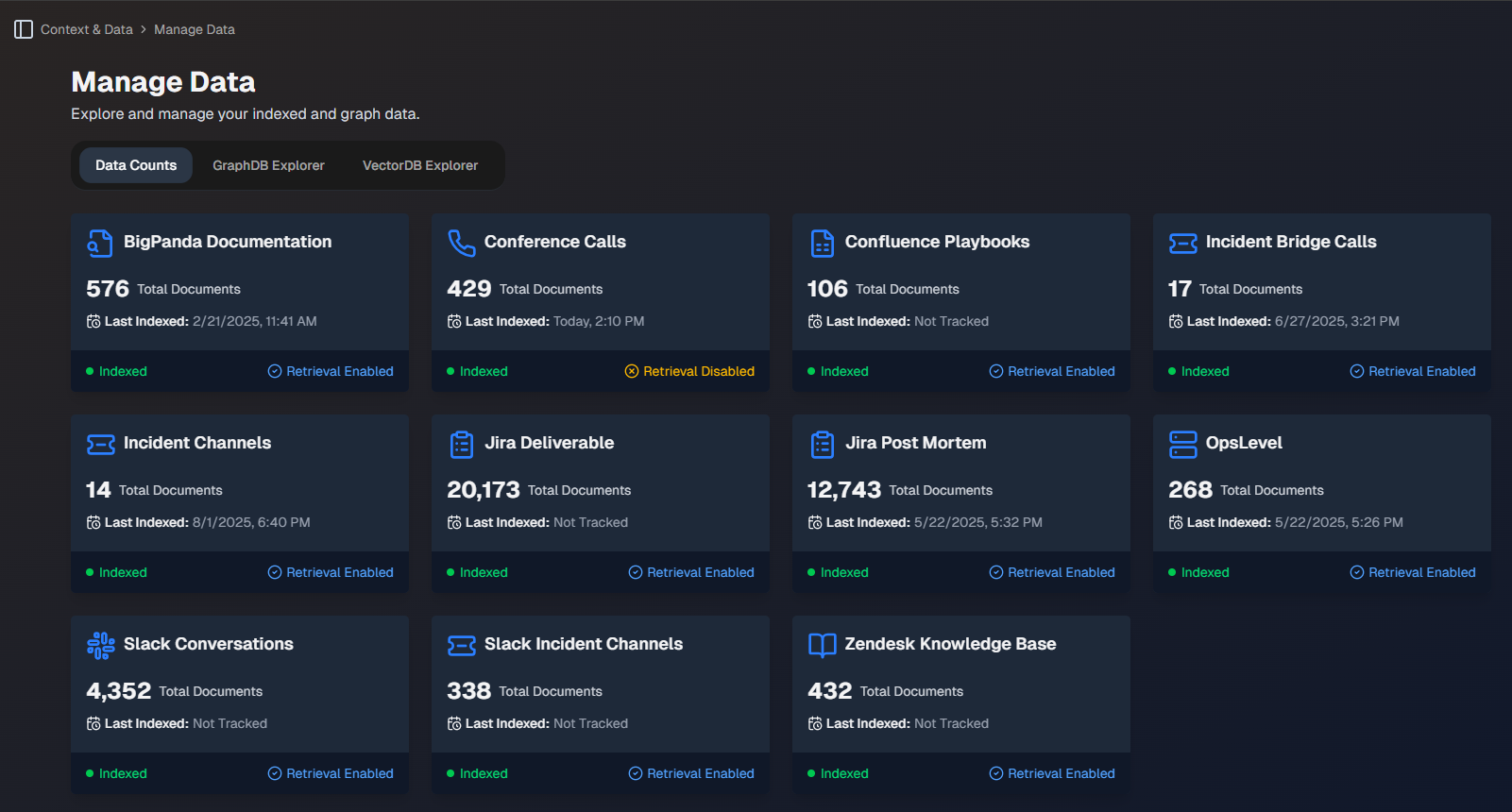
In the Vector DB Counts section, the following information is displayed for each data source:
Total number of documents
Last indexed date
Status (Retrieval enabled, retrieval disabled, or active learning)
In the Graph DB Counts section, the following information is displayed for each category:
Number of nodes
Number of relationships
Whether the graph is configured
GraphDB Explorer
The GraphDB Explorer tab provides a searchable visualization of your data. Type a keyword into the search box to find a specific document or data point. You can see all data or services that are related to or have interacted with the piece of data.
For example, you can search for the name of a specific user to see all of the incidents they have worked on.
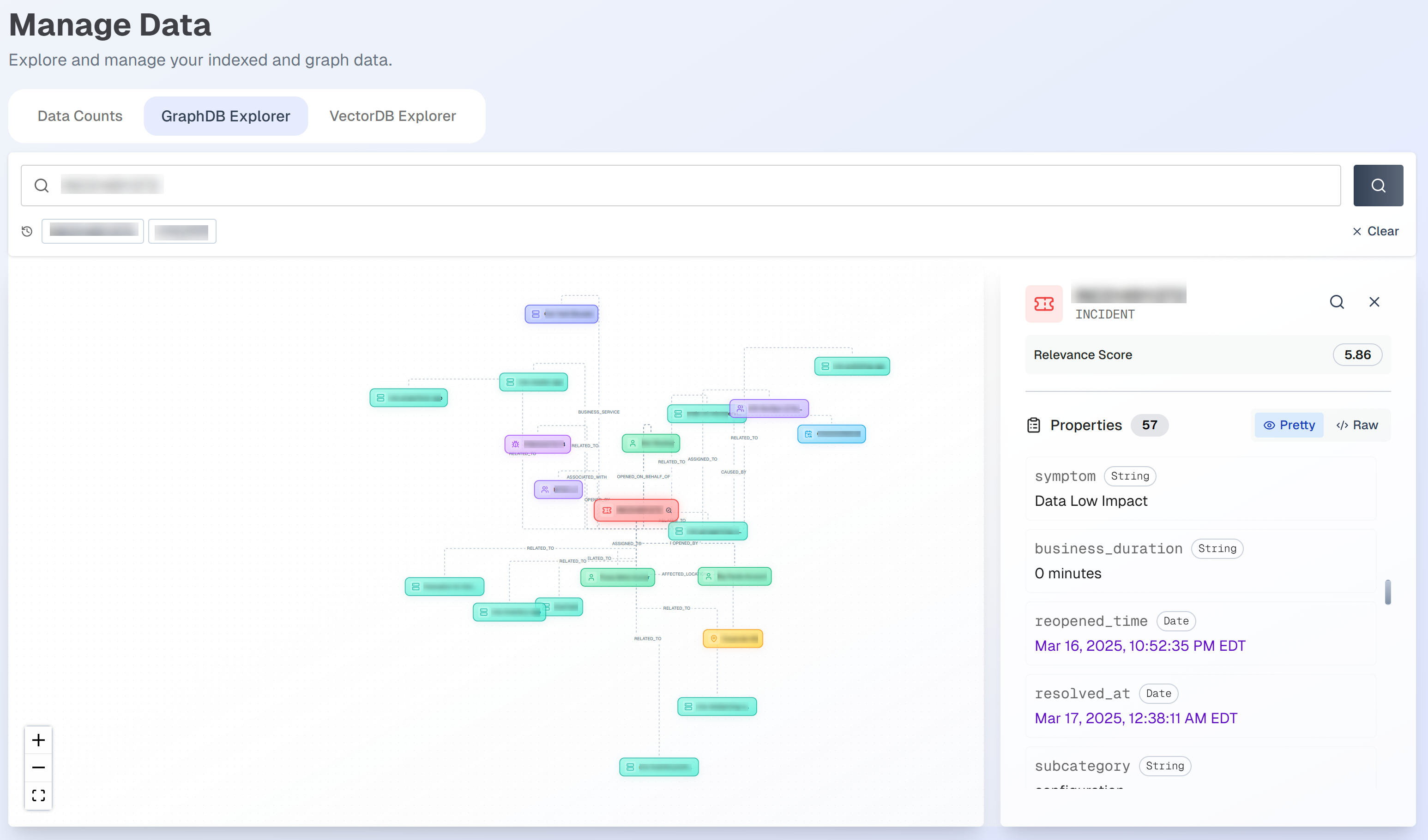
Properties related to your search result appear in the right details pane. The Relevance Score shows how closely the document matched the searched keyword.
VectorDB Explorer
Use the VectorDB Explorer tab to search for specific indexed documents. Type a keyword into the search box to view matching documents. You can use the Source dropdown menu to filter by one of your data sources.
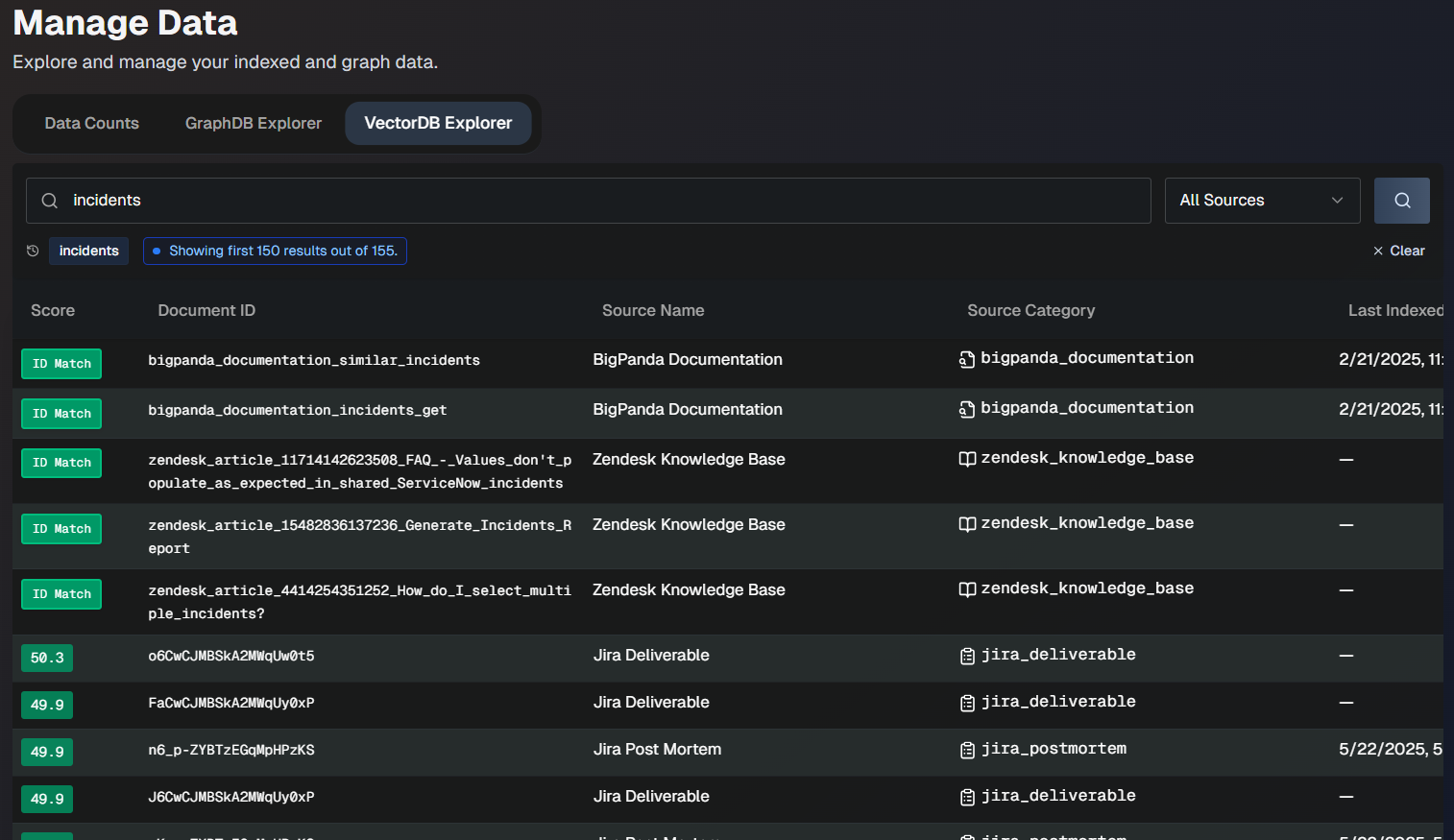
The following information for each document appears in the list:
Field | Description |
|---|---|
Score | Score of how closely the document matches the searched keyword. |
Document ID | Unique ID of the document. |
Source Name | The name of the source the document was ingested from. |
Source Category | The data category that the source is part of. |
Last Indexed | The date and time when the document was last indexed. |
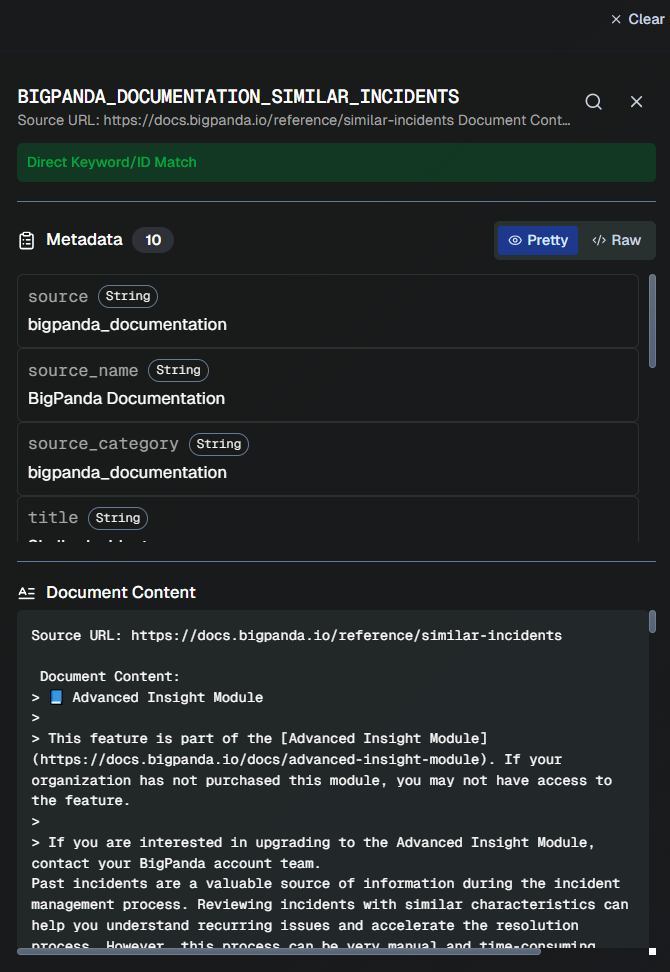
Click any document in the list to view additional details, including metadata and the full document content.
Upload Documents
To give AI Incident Assistant additional information and context, you can upload documents from ServiceNow or general file types such as runbooks, knowledge base articles, SOPs, Wikis, etc. AI Incident Assistant will automatically add content from supported file types to its knowledge base.
See Export Data for instructions on exporting from some of the most common platforms.
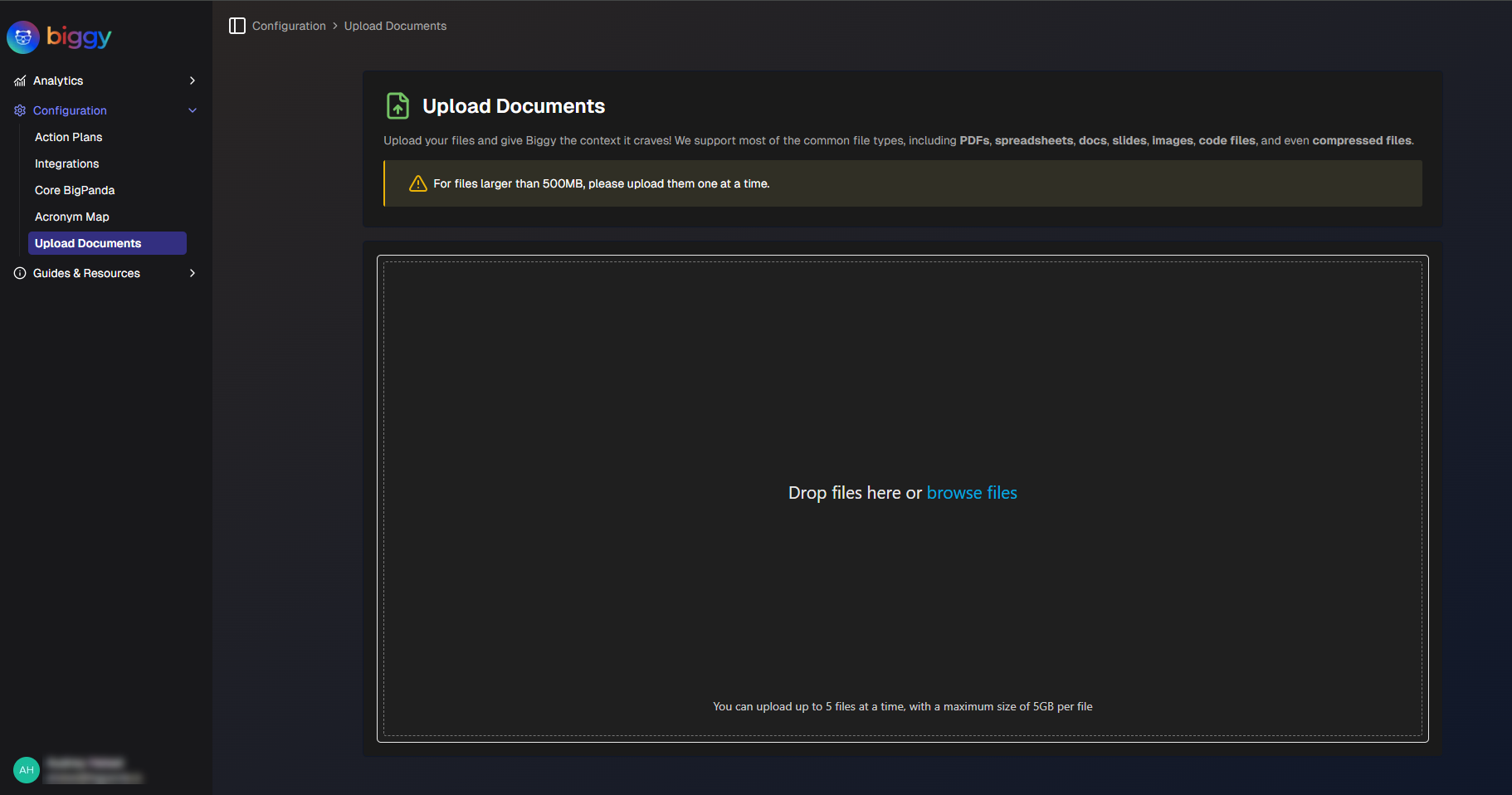
To add documents, go to Configuration > Upload Documents.
On this screen, select the General, ServiceNow, or File Transfer tab, depending on the file type you'd like to upload.
General Files
You can upload files such as runbooks, knowledge base articles, SOPs, Wikis, etc. to give AI Incident Assistant additional information and context.
The following file types are supported:
.pdf
.csv
.xlsx
.docx
.txt
.md
.html
.json
.yaml
.zip
Other file types
File types not listed above are accepted, but will not be added to AI Incident Assistant's context. They will appear in the UI with a Stored status.
The maximum file size is 5GB. You can upload up to 20 files at a time. For .zip files, the total uncompressed content size limit is 10GB. The maximum number of files contained inside a ZIP archive is 500.
File sources
Each file uploaded belongs to a source. Sources are collections of related content. When you upload multiple files at one time, they will all be added to the same source.
All existing sources appear on the Manage Data page in the Data Counts tab.
To change the source of a file, you will need to delete it and then reupload it. If you don't delete it and then reupload it and change the source, the file will exist in both sources.
Upload general files
Reuploading files
When uploading files, we highly recommend checking whether a file you are uploading already exists in the source you are uploading to. Reuploading the same file can overwrite the existing file.
See Reuploading Files for more information about this behavior.
To add files:
Click Upload Files.
In the Select Files window, drag and drop one or more files, or click to browse for files. Click Continue.
Select a source for the file(s). Choose from an Existing source or select New Source to create a new one. If you create a new source, enter a Source Name.
Reserved name
ServiceNow is a reserved name. Source names cannot begin with
servicenow. (Case insensitive)Click Upload. The upload progress appears. When the upload completes, you can view it in the General Tab.
Uploading ZIP files
When a ZIP file is uploaded, AI Incident Assistant automatically extracts and inspects each file. Any file with a supported format is automatically indexed. Files with unsupported formats are stored only, and do not become part of AI Incident Assistant's context.
The ZIP file itself does not appear as a separate piece of content in AI Incident Assistant's context; only the individual files are available as context.
If a file is uploaded outside of a ZIP archive and also uploaded within a ZIP file, it will be treated as two separate files.
Reuploading files
When you reupload a file to a Source that already has a file with the same name, you will receive a warning if the file matches the name of another file that already exists in that source. Files with the same names can exist in different sources, but not the same one together.
If you choose to upload the new file, it will overwrite the existing one. The previous version of the file will appear in the General tab, marked as Superseded status.
For example, if you upload a file called report.csv to a source, and then upload another file called report.csv to the same source, there will be one report.csv with the status of Indexed, and another report.csv with the status of Superseded in the same source.
Reuploading ZIP files
Each file extracted from a ZIP archive is tracked by its complete path within the archive, including the ZIP filename. This full path, not just the filename, is what is used to determine whether a file is new or a duplicate.
If you reupload a ZIP file with missing, existing, or additional files, the following behavior occurs:
New files - added to AI Incident Assistant's context.
Existing files - content is overwritten.
Removed files - existing files that were part of the previous ZIP archive but not the reuploaded one are not affected. AI Incident Assistant will not remove them.
For example:
For a ZIP archive containing a file called report.csv with the path of documents > runbooks > report.csv
If you upload a new version of the same ZIP archive containing a report.csv file with the path of files > reports > report.csv, it will not be considered a duplicate. Both files will be indexed separately.
If you reupload the same ZIP archive with a file with the same name and same path, the original report.csv will be overwritten. The old version will have a superseded status, and the new version will have an indexed status.
If you reupload the same ZIP archive with the file containing that path removed, the file will not be removed from AI Incident Assistant's stored knowledge.
Matches in ZIP files
When you upload a non-zip file to an existing source, you will receive a warning if the file matches the name of something already indexed there. This notification will not appear for files within ZIP archives, as AI Incident Assistant cannot inspect ZIP contents before the upload begins.
For example, if a file called report.csv was uploaded directly to a source and you upload a ZIP archive to the same source containing a file also called report.csv, they will be considered separate files. Uploading this will not overwrite the other.
Manage general files
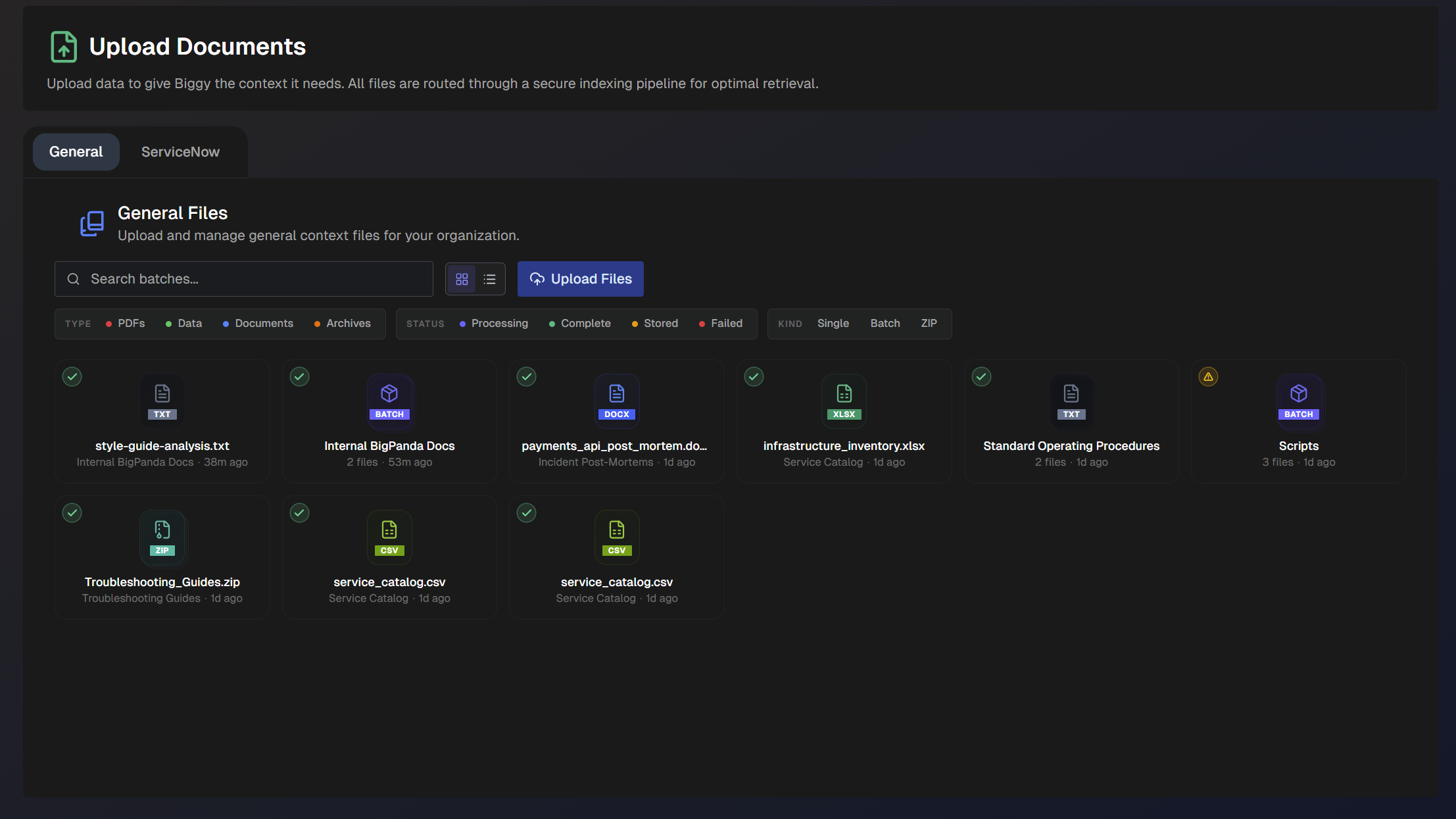
Information about each uploaded file appears on the screen. To find a specific file, use the Search box.
Click the icons to the right of the search bar to switch between a Grid View and a Table View.
In Grid View, filter the list using the Type, Status, and Kind (Single, Batch, ZIP) options.
Grid View
Click any item in the grid to view additional information in a side panel.
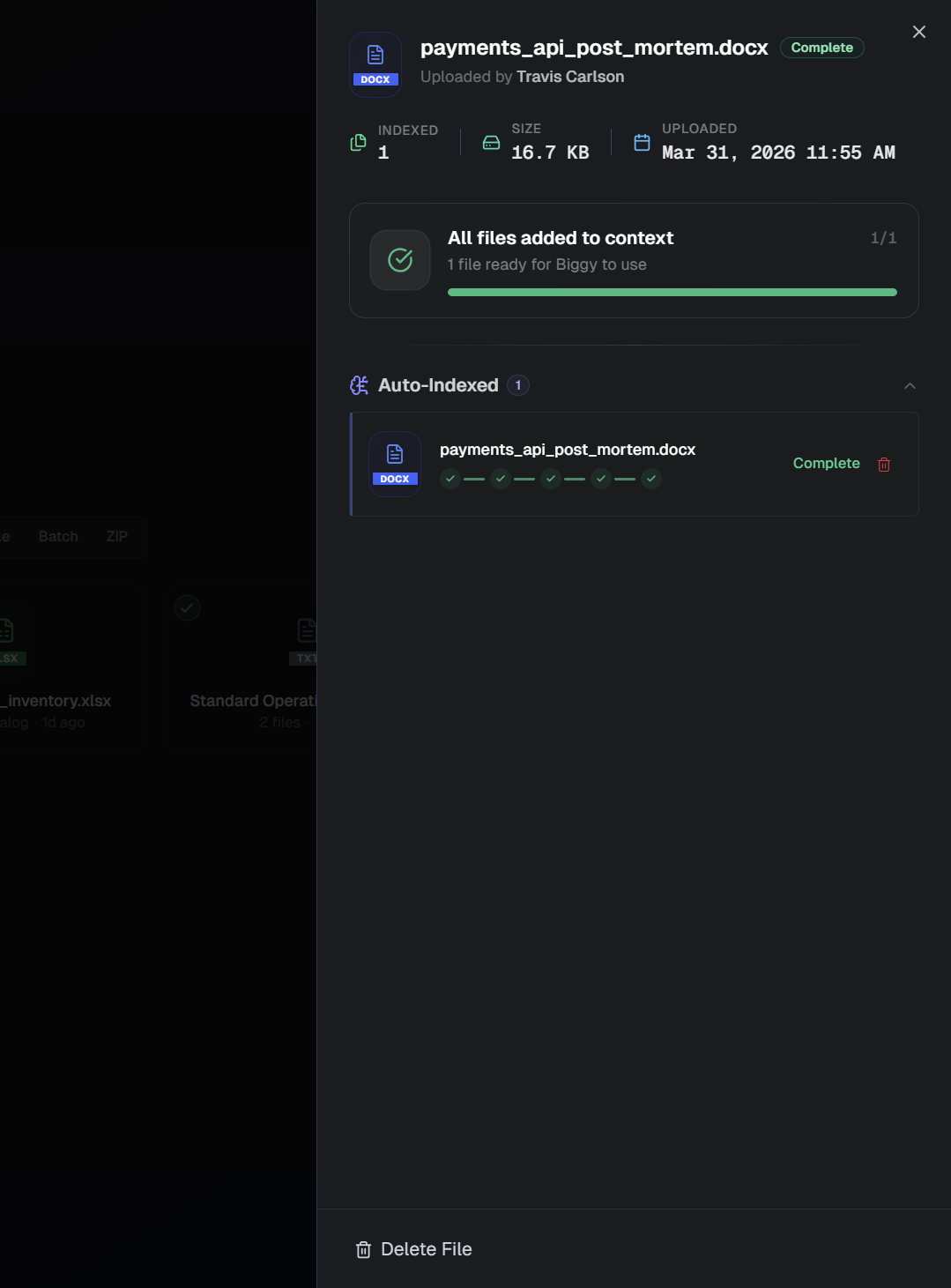
The following information about each item is available:
File type
File name
Status
Number of files indexed
File size
Uploaded date and time
Number of files auto-indexed
Statuses
The following are possible statuses:
Processing - file is in the process of being indexed
Indexed - file was indexed
Stored - file is not an accepted format for indexing
Failed - processing failed
Superseded - a newer version of the file was uploaded to the same source
Pending deletion - file is in the process of being deleted
Batch files
When you upload multiple files at one time, they will appear as a batch when viewing it in Grid View. If you click the item details, you can view the individual files within the batch.
If the file is no longer needed, click the trash can icon to delete it. This permanently removes the file from AI Incident Assistant's context.
In Table View, all files appear in a list. The following information about each uploaded file is available in Table View:
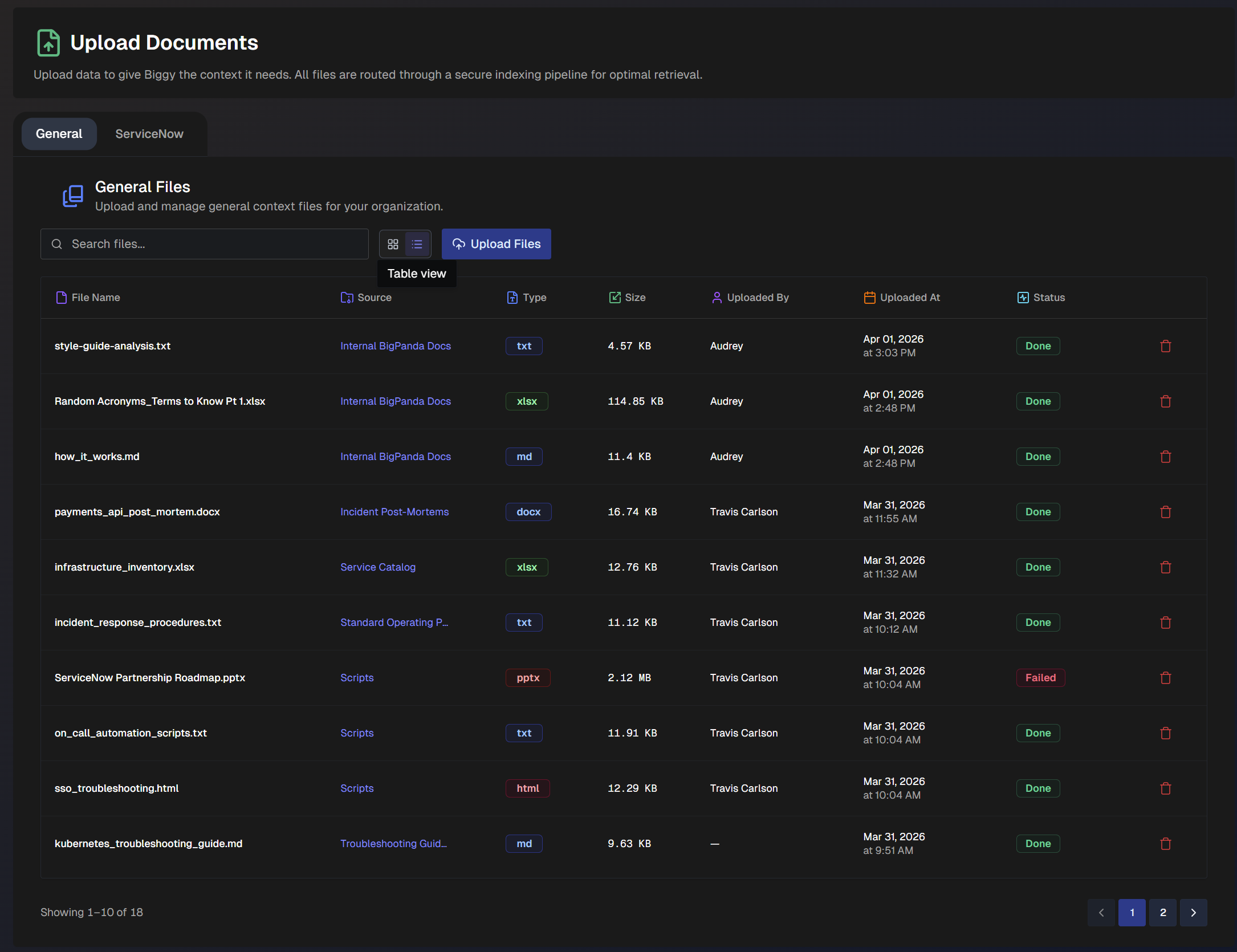
Table View
File Name
Source
Type
Size
Uploaded By
Uploaded At
Status
If a file is no longer needed, click the trash can icon to delete it. This permanently removes the file from AI Incident Assistant's context.
Upload ServiceNow Exports
In the ServiceNow tab, you can upload and manage ServiceNow exports for your organization.
Supported format
Only incident (INC), problem (PRB), change (CHG), or knowledge base (KB) CSV exports from ServiceNow are supported. The file format must match what is exported from ServiceNow.
Select Upload ServiceNow Files to add a new file. You can upload 20 files at a time, with a maximum size of 5GB per file.
The following information about each uploaded file appears on the screen:
File name
Prefix
Type
Size
Uploaded by
Uploaded at
Status
To find a specific file, use the Search box.
If a file is no longer relevant, you can delete it by clicking the trash can icon. This will send a request to the BigPanda team to delete the item from AI Incident Assistant's context.
File Transfer
Use the File Transfer tab to upload large files directly to secure storage. Files up to 10GB are supported.
Contact BigPanda for indexing
File transfers require assistance from BigPanda for indexing. Files uploaded here are stored securely, but not automatically indexed.
Export Data
Instructions for exporting data from some of the most widely used platforms are available in the links below:
ServiceNow Data Export
If you have ITIL or ITIL read_only access to your ServiceNow instance, use the URL below to export relevant ServiceNow tables with all records:
https://<instance>.service-now.com/<table>_list.do?CSV&sysparm_default_export_fields=all
Replace the fields in brackets with your instance name and the table you'd like to export.
You can export any default or custom table. The most commonly exported tables for AI Incident Assistant are incident, problem, change_request, task, change_task, kb_knowledge, and cmdb_ci_appl.
If you'd like to limit the records included in the export, you can use an encoded query. Use the URL below to include an encoded query:
https://<instance>.service-now.com/<table>_list.do?CSV&sysparm_query=<encoded_query>&sysparm_default_export_fields=all
You can build the encoded query in the ServiceNow UI and then replace the <encoded_query> field in the URL.
Next Steps
Get a high-level overview of how AI Incident Assistant works in the AI Incident Assistant documentation.
Learn how operators can Manage Incidents with AI Incident Assistant.